Although I’ve worked a lot on psychoanalysis, I consider myself a non-nostalgic person, in general not very prone to looking back at previous decades of my life. However, in the current era of major crises and rapid and radical changes, I cannot help but wonder how different my student years were.
I started university in 1989, in the faculty of philosophy. Fred Truyen, still very young but with his characteristic smile and mustache, was my mentor in the first year, an analytic philosopher before he also chose another path in the Arts faculty. My choice was motivated by a deep fondness for Greek and Latin. However, my lack of philological rigor ruled out Classics in Leuven, a far cry from the romanticism of ‘dark academia’ as a viable option. I also read voraciously throughout my teenage years and was fascinated by the work of Freud. So, between literature and psychology, philosophy seemed like the best choice. Unfortunately, the reality was rather different. Led by old wise (white) men, the philosophy program was dominated by Thomas Aquinas, with some phenomenology and logic as a consolation prize. When I checked out the courses for the second year, I only saw more Aquinas and Saint-Augustine…
We were only a handful of students in the first year. Most of them male, like the professors, and all cultivating some form of neurosis. No one seemed remotely interested in contact with fellow students. Still quite young, I did not feel ready for university yet. After the first mock examinations – a preparation for the real exam period in June, when all courses were examined – I realized I was in the wrong place. I took on various student jobs and left for the United States, where my uncle was doing a PhD at Cornell. I spent six months in the small town of Ithaca, New York, teaching myself German, working as a volunteer in a secondhand bookstore, and sitting in on philosophy courses. This was an exciting period at Cornell: the debate about Heidegger’s involvement with Nazism raged in full force on the campus, Adorno and Derrida were defended by radically opposing camps. Although I was an outsider and a dilettante, my brief glimpses of this Ivy League institution conformed to my naïve phantasies about university much more than Leuven ever had. Still, I did not live on the campus but in the small town of Ithaca. It was from my roommate Melissa, an anthropology major who had dropped out after she had a child, and my friend Soo Lee, a painter, that I learned the basics about life that I needed at that time.
When I came back to Leuven, I enrolled in ‘Germanic philology’ as it was then called. These were the days before the unification of higher education in the EU, the so-called Bologna agreements, when all universities in Europe (reluctantly) adopted Bachelor and Master programs and international exchange became possible. In “Germaanse” as it was called for short, students were required to study the literature and linguistics of two Germanic languages, in my case English and German, as well as general and comparative literature and linguistics. I would not say that the first years of the program were a huge improvement compared to philosophy, but literature and linguistics were closer to home, and I was better prepared. Especially in the two final years, when I was able to combine English and theory, I found my calling: poststructuralist theory and psychoanalysis through the work of Paul Auster. Working on my thesis finally opened a path to what would become an academic future. It offered an outlet for creativity and deep thinking, rather than studying by heart – never my forte (I’m not overly fond of the details) – and I developed a passionate love-hate relationship with writing.
I was not a typical university student in the sense that I grew up in Leuven and already had a network of friends there when I started university. I always lived in shared student houses that were as cheap as they were unsafe. The main rule was never to contact the landlord about anything.
For years, I had to go swimming in the retro swimming pool in the city center when I wanted to shower because I was afraid of the huge mushroom growing in the shared bathroom.
We had no cell phones and the phone on the first floor of our house was locked with a key, so that we could only receive calls, not make them. But we always found our way in the vibrant, but definitely more grubby, nightlife of Leuven. There were the faculty bars with different specialties. In the philosophy bar, hidden in the basement of HIW, cheap whiskey was served by American PhD students. The Arts ‘fakbar’, still in the same place today and now our neighbors, offered late-night dancing, and the psychology bar called ‘de Shrink’, in the place where now Alma I is, featured riotous punk and new wave gigs in a tiny space. Throughout Leuven, small venues and clubs, with exotic and provocative names like Corso, Rumba, Belgisch Congo and ‘de Lido’ (around the corner from the Arts building also known as the ‘Kremlin’) were scattered. In the mid-nineties, a legendary club ‘Silo’ opened in a warehouse in the derelict Vaartkom area, serving food and techno (not my scene). The last red-light bars in the Maria-Theresiastraat, that mysteriously offered beer and Coca-Cola at exorbitant prices, had closed around that time. There always seemed to be a party somewhere. On the wekends, we went home to recover.
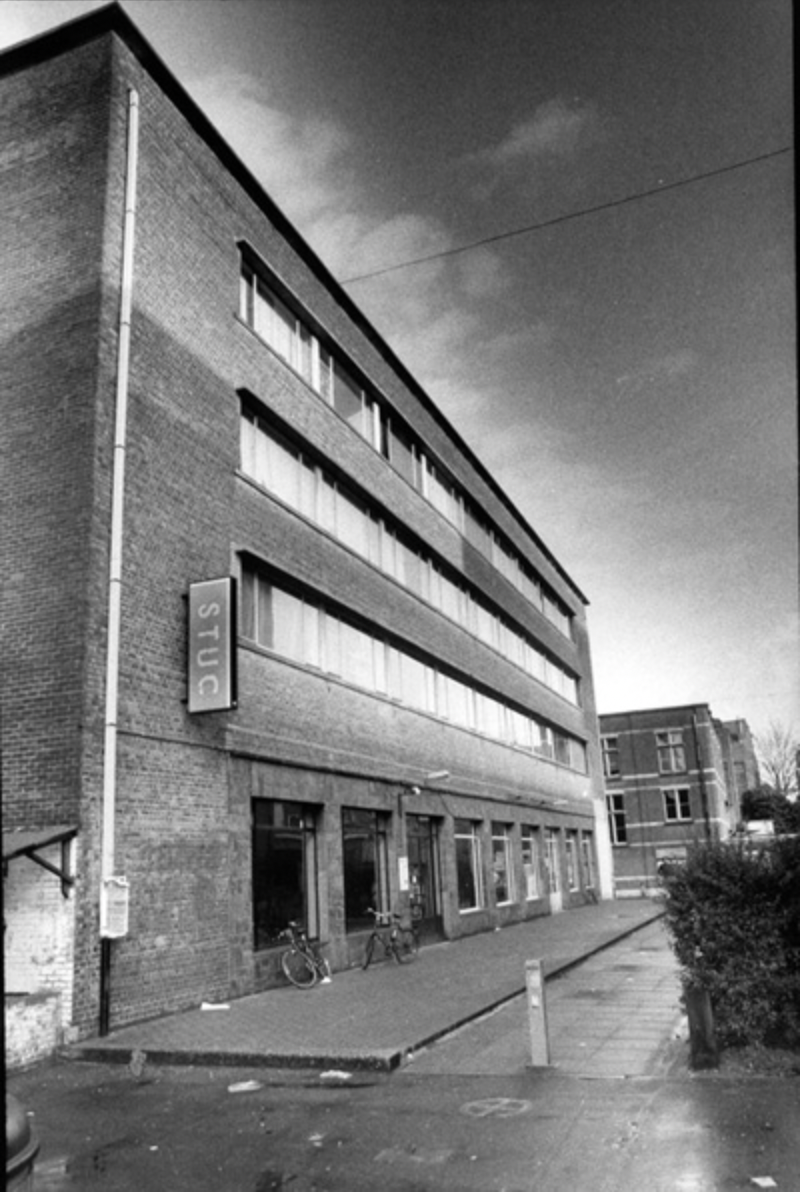
The house that I shared with friends was opposite the small pathway towards the Social Sciences buildings. At the time, this was where ‘t Stuc, the student arts center (later called STUK), and ISOL, the international student bar (now Pangaea), were located. ‘t Stuc consisted of a cafeteria with large windows looking out on a courtyard and a blind wall.
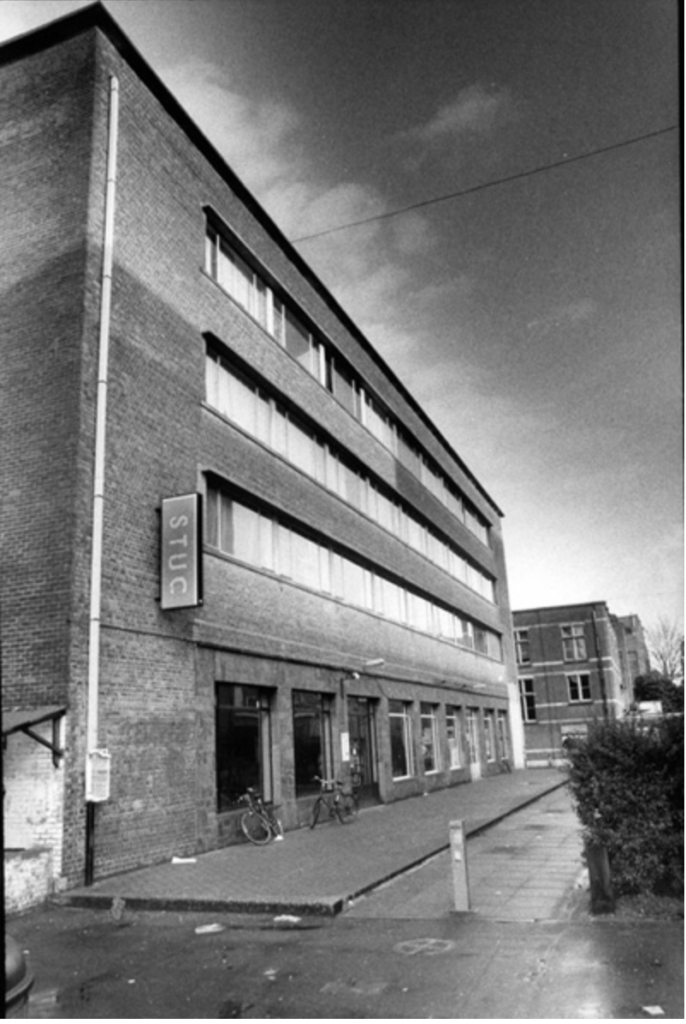
This became an extended living room where I met a circle of young sociologists and philosophers, as well as some of the first Erasmus students in Leuven, but where I also wrote my student essays in longhand on quiet afternoons. Next to the café was a polyvalent room for theatre and film: the hotspot for the ‘Flemish Wave’ that I now teach. A lot of Flemish and international experimental dance and theatre passed through there, culminating in the Klapstuk festival. While I saw some of it, and hung out with some of the actors and dancers late at night in ‘t Stuc after performances or residencies, my real passion was underground film and music. I discovered the work of David Cronenberg and David Lynch, alongside film classics that were projected outside during spring and summer evenings and video and early digital art.
Reading, music and film accompanied me through my student years. In the extra postgraduate year of literary theory – a badly organized, experimental program hosted by the four Flemish universities Antwerp, Brussels, Ghent and Leuven – I worked at the Leuven Film Studios, an arthouse film complex. This was my ideal job: free film tickets and plenty of time to read, with punctual interruptions on Wednesday afternoon when traumatized children and clumsy fathers came for emergency ice cream when the Lion King’s father had died. In the evenings, I tried not to get involved in the heated discussions between cinema complex owner Jan Rastelli, a hugely important figure for Belgian cinema, and his wife.
I had a lot of friends, but I was also introverted and at times somewhat melancholic.
For a long time, I did not have many visions for the future, much less goals or a career plan. We did not feel that we had to network or look for internships.
In the aftermath of the ‘no future’ of punk and New Wave (a bit later in Belgium), we were very much living day by day. But it was clear that the world was changing quite fast. The fall of the Berlin Wall changed the power dynamics in the world. Apartheid in South Africa was abolished, Israel waged wars against the Palestinians and neighboring countries. In Flanders and elsewhere, right-wing movements were regaining territory and we demonstrated against fascist student movements, racism and nuclear bombs (it did not help). The first time I used a computer was for my thesis: an old Atari that I’d borrowed from someone, with a line printer and large floppy disks. The first search engine that I used, one year later, was called ‘Ask Jeeves’, after a butler character in a popular British book series. The results were underwhelming.

For us, research meant going to the library. We worked with indexes and thesauruses that were printed and updated yearly. I spent hours roaming through stacks of books, often carried away by random surprise findings, taking countless photocopies, with parts of my hand on the different positions of the page. After my second thesis for the post-graduate program on the work of Hélène Cixous, I began to contemplate research more seriously. At first this seemed like a long shot. Funding was only for consistent top students and my learning curve was best described as gradual (the first years of German were a challenge). I was lucky that a position of ‘assistant’ opened up in ‘General and Comparative Literary Theory’. The section was led by four professors relatively close to retirement. I was to assist all of them, which meant that I had to immerse myself in systems and field theory, semiotics, literary theory and children’s literature, while at the same time working on psychoanalysis and poststructuralist theory for my PhD and teaching Psychoanalysis and literature. Here, my natural curiosity and love of reading were assets. I was given six years to develop into a more generalist type of scholar, which gave me time to participate in reading groups in literary theory, philosophy and psychoanalysis. It took almost seven years to complete my PhD.
This was a time when doctoral research was regarded as a vocation. A PhD of over five hundred pages long was considered normal and researchers were supposed to ‘mature’ before publishing at all. And yet, when I graduated in 2002, the world, and academia, even in Leuven, had already become radically different. Digital media, from smartphones to social media, wormed their way into our lives at an incredible speed. Five-hundred-page-long dissertations were no longer popular with publishers and needed to be heavily reworked to become publishable. Academic careers were increasingly monitored in terms of output and peer-reviewed articles, rather than books. The competition in academia became much greater. This also had good sides. The growing awareness of the restricted access to research and culture led to more diversity on the level of PhD researchers. Growing internationalization enriched research, even if the dominance of Anglophone culture and theory overshadowed Belgium’s intellectual position at the crossroads of French, German, Dutch and English traditions. Postcolonial, gender and queer issues were no longer brushed aside, as they were by the poststructuralist star thinkers of the 1990s, who, in hindsight, were often quite patriarchal and elitist. Under decades of socialist governance, Leuven was thoroughly cleaned up. From a grey, unappealing, provincial town it transformed into the much more beautiful and sustainable city that it is today.
The pressures of the rapidly changing society today are huge. It is very hard to remain positive, even for an optimist like me. Yet, some of the overwhelming anxieties – war, ecology, rising fascism, global inequality, neoliberal and other forms of capitalism – were already very present in the 1980s and 1990s when I grew up, albeit on a very different scale. The memories of my student days are a mixed bag: exhilarating moments at the discovery of new theories, literature, music, films and art. Lots of dancing and unexpected encounters that led to long-term friendships and connections. But also doubts and anxieties in times of turbulence and change, where we did not see a bright future ahead.
Especially for women, the expectations in general were not so high. For me personally, this was an advantage. It gave me the freedom to follow my own path.
But I’ve always realized how fortunate and privileged I was to be able to do it all.
Times are changing, constantly, rapidly, unpredictably. We cannot but roll with them into uncertain futures and hope for the best.
This piece was originally published in Issue 1 of the print edition of Ordinary Matters magazine.

Leave a Reply