
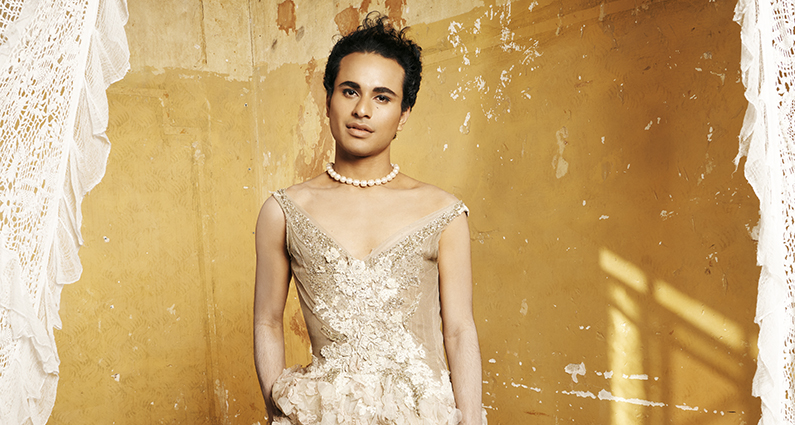
His image appears on the screen, cap and smile on. I greet him in Spanish and press record on my phone as he introduces me to Leila, the beautiful dog who travels around the world with him. So began my conversation with the Venezuelan male soprano* Samuel Mariño, one day after the first queer theory class, in the Capita Selecta course, that had me thinking about whether and how I relate to heteronormativity. As a queer musicologist, the interview with Mariño (for a piece in a Portuguese newspaper) was not only a happy coincidence but also a thought-provoking one.
Reflecting on Samuel Mariño’s and my own experience, I argue that finding our own voice can be an act of queering, defying heteronormative regimes of listening, and contributing to Muñoz’s “notion of the utopian performative” (Muñoz 2009, 100).
Our voice is often understood as “a cue to interiority, essence, and unmediated identity” as Nina Sun Eidsheim puts it in The Race of Sound (Eidsheim 2019, 2). This is particularly strong in relation to singers, whose voices are frequently taken to express the underlying truth of the artistic self. Yet, that is not necessarily true. Sounding voice exists, as music does, only as a psychoacoustic phenomenon: an “intermaterial vibrational practice” (Eidsheim 2015, 161), that is, a product of resonance, vibration, air, architecture, and human perception. In other words, that means “the voice does not arise solely from the vocalizer; it is created just as much within the process of listening” (Eidsheim 2019, 11). To this notion, we can add the two other lessons Eidhseim draws: that voice is collective rather than singular (emerging from a web of complex bodily and environmental interaction), and that voice is cultural rather than innate (Eidsheim 2019, 9).
Listening, too, is not neutral. It is shaped by a heteronormative regime that determines which voices are deemed ‘natural’ or ‘legitimate’. Anything outside its framework — such as a binary opposition of low ‘masculine’ versus high ‘feminine’ — is often viewed as broken or wrong.
That was Samuel Mariño’s experience. He was bullied throughout his adolescence because of his voice, with his high register becoming a target of mockery. He begged his parents for surgery to “fix” it, until a doctor suggested he try singing opera. Today, he is an internationally successful male soprano with one of the rarest voice types. Yet he continues to receive online harassment, which demonstrates how deeply heteronormative listening practices still govern whose voices are treated as legitimate.
My point is not simply that Mariño’s voice is queer because it disrupts normative expectations or that his singing makes audible the fact that the association between voice and gender identity is not natural, but historically and culturally naturalised, though both are true. Following Freya Jarman-Ivens’s reasoning in Queer Voices, the voice “holds queer potential” precisely because: 1) it mediates between body and language (both historically gendered); 2) it exists in the relational “third space” between speaker and listener; 3) it is both genderless in itself and performative in its effects (Jarman-Ivens 2011, 18).
Jarman-Ivens develops her argument on Judith Peraino’s Listening to the Sirens, where the author shows how music can prompt us to question “the ideological superstructure of ‘compulsory heterosexuality.’” (Peraino 2006, 5). Responding to the “call of the Sirens” can be a way of embracing one’s queerness, as music challenges norms, expresses unapproved desires, and fosters new forms of subjectivity. (Peraino 2006, 7-9).
In this view, the voice, as the example of Mariños illustrates, is not simply something one has, but “a perpetual becoming”, which “potentiality is scouting for a “not here” or “not now” [… and that] suggests a futurity” (Muñoz 2009, 99). For example, when Mariño performs repertoire written for castrati (in itself quite a problematic historical practice in terms of gender and patriarchal control by the church) he is at the same time opening a temporal space in which the strict alignment of voice, gender, and body is loosened, reclaiming and reshaping that space in which the tradition is heard (not only through his voice but also the way he present himself with joy, glitter, humour, dresses designed by himself, high heels, etc… challenging some respectability norms long embedded in classical music). Following Muñoz and Jarman-Ivens, we could conclude that queer voice is (not just a) form of identity, but a collective, future-oriented practice of imagining and sounding other ways of living on stage.
In addition, this queerness of becoming also resonates with the search for our subjective voice — who am I and what I want to say to the world —, which is always a negotiation with heteronormative norms. Growing up in a working-class family, I learned to associate certain desires with shame. Wanting to become a classical pianist, for instance, felt parallel to being gay: a pleasure I was not meant to have. There’s not enough space in this essay to unfold this feeling of shame and guilt. But Cathy J. Cohen is instructive here, as her intersectional framework provides a vocabulary to question this normative power. She uses the concept of queer “to think about how we might construct a new political identity that is truly liberating, transformative, and inclusive of all those who stand on the outside of the dominant constructed norm of state-sanctioned white middle- and upper-class heterosexuality” (Cohen 1997, 25) since heteronormativity, she argues, “works to support and reinforce institutional racism, patriarchy, and class exploitation” (Cohen 1997, 40).
That explains my sense of displacement in the classical world. And how, even being an opera star, Mariño still feels that he doesn’t belong to that world, “not only of white, but with people with a lot of money or whose family had a music background”, as he described. At the same time, we are part of it. Finding our own voice is therefore an act of resistance: to insist on sounding ourselves even if our silence or assimilation is preferred — we’re here, we’re queer, and you’re listening to our voices.
*A male soprano or sopranist is a type of voice that can sing in the highest vocal register without resorting to falsetto, a technique typically used by countertenors.
References
Cohen, Cathy J. 2005. “Punks, Bulldaggers, and Welfare Queens: The Radical Potential of Queer Politics?” [1997], in Black Queer Studies: A Critical Anthology, eds. E. Patrick Johnson and Mae G. Henderson, Durham, NC: Duke University Press.
Eidsheim, Nina Sun. 2015. Sensing Sound: Singing & Listening as Vibrational Practice. Sign, Storage, Transmission. Duke university press.
Eidsheim, Nina Sun. 2019. The Race of Sound: Listening, Timbre, and Vocality in African American Music. Refiguring American Music. Duke University Press.
Jarman-Ivens, Freya. 2011. Queer Voices: Technologies, Vocalities, and the Musical Flaw. First edition. Palgrave Macmillan’s Critical Studies in Gender, Sexuality, and Culture. Palgrave Macmillan.
Muñoz, José Esteban. 2009. Cruising Utopia: The Then and There of Queer Futurity. Sexual Cultures. New York University Press.
Peraino, Judith Ann. 2006. Listening to the Sirens: Musical Technologies of Queer Identity from Homer to Hedwig. University of California Press.

Leave a Reply