You have arrived, congratulations
now take this time for yourself
be welcome and comfortable
let yourself be guided by these works […]
not afraid of what you don’t understand yet,
and slowly, something might shift
I hope you wake up refreshed 1
Every year, the city of Leuven becomes a meeting point for artists, performers, thinkers, and curious visitors through Artefact, a multidisciplinary festival organized by STUK – House for Dance, Image and Sound, that blends visual art, performances, talks, film, and the most disparate installations. Rather than presenting art in a traditional museum format, Artefact invites audiences to move through a hybrid cultural landscape where exhibitions coexist with concerts, seminars, workshops, and immersive experiences. The festival’s strength lies precisely in this mixture: it encourages visitors not only to observe art but also to encounter it across different media and contexts.
This year, however, Artefact proposed something different from what is usually expected of an exhibition. Running for eighteen days, from 12th February to 1st March, this year’s edition, Grind Grind Grind, Release. An Exhibition as a Massage, invited visitors to let go of excessive conceptualization and experience the exhibition with all five senses, viscerally and intuitively. Born from the question of how an exhibition space might be transformed into an experience that feels like a massage – from which the title of this edition also derives – the artworks selected and created for the festival share a strong sensory impact that emerges from the very first encounter. Visual, auditory, and even olfactory elements played a central role.
Visitors were thus guided through a path experienced first and foremost through the body rather than the intellect: a journey felt through the skin before it was processed by the mind, which, unusually for an art exhibition, was deliberately relegated to a secondary role.
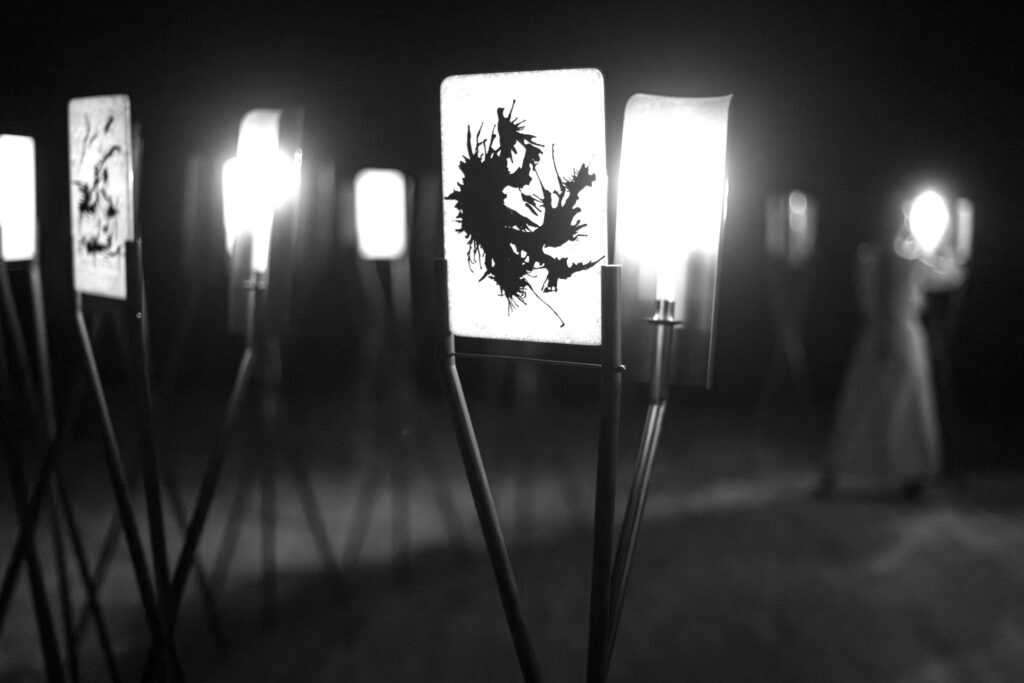
Already in the first room, this concept became tangible through works that invited visitors to reconnect with the materiality of their own bodies: bodies that are “warmblooded and earthbound”, matter among other matter, and whose sensations emerge through their relation to others and to the surrounding environment. Indeed, all the senses were immediately activated. Not only sight – struck at once by the massive, dark sculpture that crawled from the ceiling to the floor – but also smell, as the work asserts its presence not only through the space it occupies but also through the intense scent emanating from the materials used to construct it. For this piece, Slaying the Hydra, created specifically for Artefact, British artist Nicola Turner uses wool and horsehair retrieved from the stuffing of old mattresses and chairs. She twists these fibres into dark tendrils, which she then braids into larger, sprawling compositions, each time adapting them to the space that hosts them. The organic materials impose their presence in the room not only visually but also through their intrinsic natural smell, provoking contrasting reactions among visitors: for some, the smell might evoke pleasant childhood memories of the countryside; for others, it might produce a sense of repulsion or abjection. Still others might respond with a cautious curiosity, approaching the sculpture to touch these dead materials that feel at once familiar and strangely alien.
While the visitor was engaged with this almost creature-like form, the room’s soundscape further intensified the oscillation between comfort and discomfort. At the back of the room, the video Warmblooded and Earthbound by Lithuanian artist Eglė Budvytytė, which explores our relationship with the natural environment and reminds us of our deep connection to it, filled the space with an immersive soundscape – one built, too, on sensory oxymorons, soft and harsh, pleasant and unpleasant, visceral and embodied, lived by each visitor differently, filtered through personal memories and past experiences.
The central core of the exhibition was therefore the body, our body, though understood in a broader sense. After this first, impactful introduction, which reconnected us with the materiality of our own being, the narrative shifted to another level, presenting us as bodies that desire, bodies that yearn. And more often than not, that yearning takes the form of a longing for love, for a place to land, for somewhere to belong. This desire was expressed through artworks that approached it in a visceral, almost tangible way, subtly transforming the atmosphere of the space: an unfulfilled kiss between two spotlights, so close they could almost touch yet never will (in Ange Leccia’s Le Baiser); a poem about love and the need to be loved that can never be fully read, as the video superimposed on it produces a flicker so intense it becomes unbearable to watch (in James Richards’ Negative Hands); and photographs by Hervé Guibert depicting empty rooms, empty spaces, unmade beds, and open books that bear witness to a past presence that remains perceptible: sites charged with memory and emotion, haunted by the invisible presence of those who once inhabited them. Taken together, these works formed a kind of compendium on the theme of desire: on the meaning it assumes, on how it manifests and transforms into emotions and physical, almost tangible sensations, inviting us to reflect on the relationship between body, memory, and longing.
The question of belonging, the other common thread connected to the body, was then powerfully explored, taking on a slightly more political stance, through the installations of Bahamian artist Tavares Strachan and Mexican video artist Vir Andres Hera. Strachan’s iconic neon work appeared in the form of the sign You Belong Here, placed right in front of the room entrance, standing out in its blue glow, and inviting visitors to consider the real meaning behind such apparently simple words. In this work, politics and poetics merge to make us reflect on who has and how one has the right to belong: in other words, as explained in the catalogue, “the phrase can shift from invitation to injunction, subtly implying that one does not naturally belong, that belonging is conditional, or that certain bodies are more readily accepted than others”. Building on Strachan’s work and its questions of how we fit in or belong, Hera’s 5-channel film installation, Amoxtli – a 70-minute-long movie in seven chapters, which opens up a space to reflect on what home, belonging, and family truly mean –, continued the conversation, shifting it from the individual to the collective dimension, from the self to the role that friends and (chosen) family play in creating a place where one can belong.
This is only a glimpse of this heterogeneous, multifaceted exhibition – one that seemed to take visitors by the hand and guide them step by step through an experience where, to quote writer Cassie Packard, “Pleasure, while probable, is neither guaranteed nor total. There’s always the off chance you’ll grind your teeth to dust.” Yet the exhibition delivered on its promises: while tension was palpable in the first rooms, the experience gradually moved from grind to release, allowing visitors to unwind and find moments of calm along the way. Drifting from room to room, grinding from artwork to artwork, the exhibition gradually identified its visitors’ tensions and sore spots before gently guiding them toward release. Like a skilled massage therapist who first locates the knots before easing them with firm yet careful pressure, the exhibition ultimately allowed visitors to pause, take a deep breath, and relax.
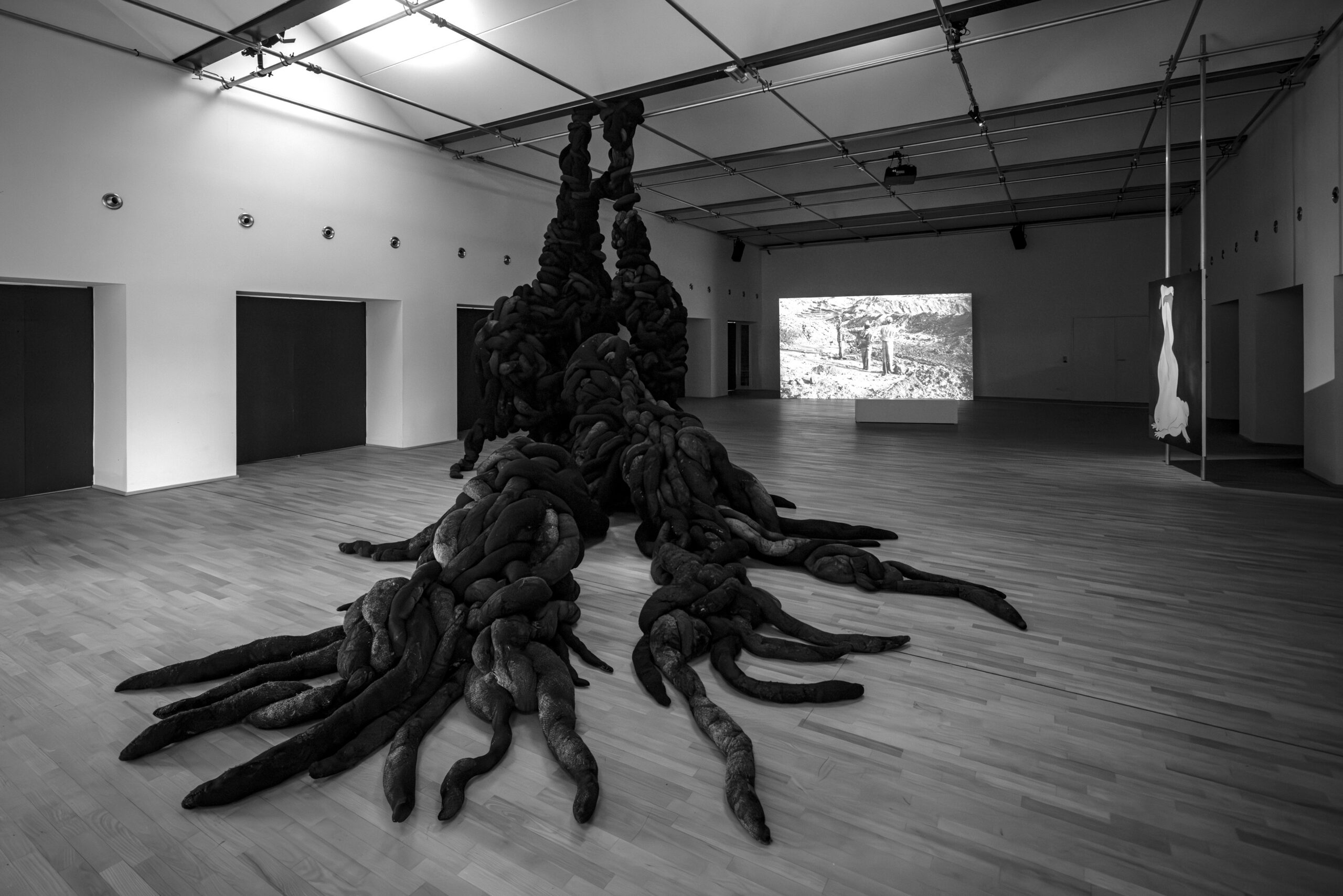
Emblematic in offering a moment of pause from the daily grind and daily worries was Lee Mingwei’s performative installation Chaque souffle une danse, which found its second iteration and its European première at STUK. Born from a meditative practice the artist adopted while coping with an overwhelming period of stress, this elliptical composition of alabaster slabs on tripod stands unfolded in two moments: in its static form, the installation gave shape to one of the most underrated and taken-for-granted actions of human life, breathing, through its delicate ink drawings; as soon as the dance performance was enacted, the visitor was carried further into the artist’s act of creation, immersed in the tranquillity and peace he has discovered. In sum, overwhelmed by the world we live in and the unrelenting flow of (often distressing) global news, Mingwei’s installation seeks to offer relief and ease the tensions that accompany us daily.
The exhibition concluded with an installation that brought together the visual art and sound programs: BODIES AND SUBWOOFERS (B.A.S.) by Brazilian artist Stefanie Egedy. Described by the artist herself as “a sort of sound hug,” this new iteration of her ongoing body of work, which investigates the physical effects that low-frequency sound waves exert on the human body, offered visitors a final, almost literal massage. Through deep vibrations emitted by powerful subwoofers, the installation invited participants to experience sound not only as something to be heard but also as something to be physically felt, resonating throughout the body.
Lee Mingwei, Chaque souffle une danse, 2024 – Performance by Aya Sone at STUK, House for Dance, Image & Sound, 2026 © Kristof Vrancken
The list of artworks could go on and on, as the exhibition comprised a total of 24 different pieces, by 19 different artists – not including the performers involved in the Artefact Sound Program which, running parallel to the exhibition, offered a wide range of live performances and sonic experiments that expanded the festival’s exploration of the body and sensory experience. Taken together, art, sound, film, and performances of all sorts, managed to provide a 360-degree experience accessible to all, a different and stimulating itinerary through contemporary cultural forms, which even though they might not have had immediate resonance or familiarity, were able to open up new spaces in our minds, new ways of understanding not only art but also ourselves.
Overall, what made this exhibition especially compelling was indeed its ability to let us reconnect with ourselves, with our bodies, with our surroundings. At a time when everything seems to move faster and faster, when we are constantly required to be productive, to perform, to remain in motion, when we are endlessly bombarded with information, news, and events, and when time itself appears to shrink, we often forget to pay attention to our bodily sensations, to ask what they might mean, or simply to listen to what our bodies are telling us. Yet our bodies are far more eloquent than we might expect, carrying us every day through a world that at times feels increasingly demanding and disorienting. For those three weeks, then, Artefact offered a space to reconsider these often-overlooked gestures, reactions, and sensations: a place where daily worries could momentarily fade, allowing visitors to slow down and inhabit the present more fully.
So, in the end, we can definitely say: we woke up refreshed!
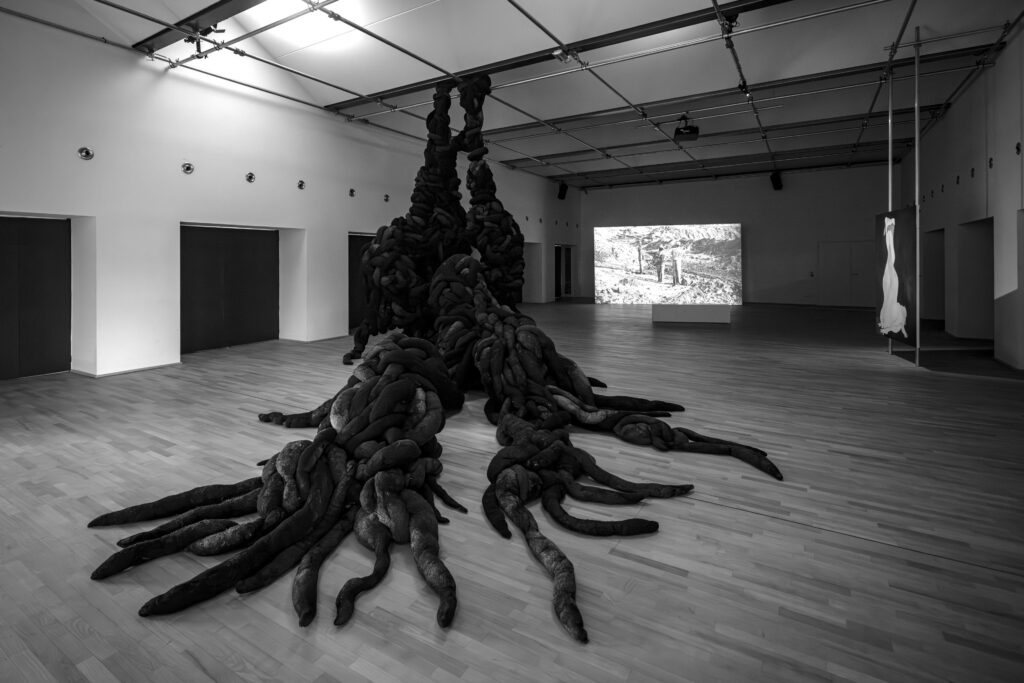
Nicola Turner, Slaying the Hydra, 2026 / Eglė Budvytytė, Warmblooded and Earthbound, 2024 / Carlotta Bailly-Borg, Déliquesence, 2026 – Installation view STUK, House for Dance, Image & Sound, 2026 © Kristof Vrancken
- An Exhibition as a Massage walltext by curator Karen Verschooren. ↩︎
This piece was originally published in Issue 1 of the print edition of Ordinary Matters magazine.

Leave a Reply