Content Warning: Colonisation, Exploitation cinema, Mondo cinema
The archive is not a neutral container of history. It is a process of reduction. To archive means to select and exclude. It determines what is allowed to be seen and what material ought to be forgotten. What remains outside the archive is often not what lacks meaning, but what is deemed too problematic, too uncomfortable, to preserve.
Archives are often constructed not only through the preservation of documents, objects, photographs and other material, but also in what Foucault called the ‘space of appearance’. This space of appearance, or what is selected to be present in the archive, is a direct result of the distancing constructed by the archive as a deposit of completed past time, towards a more mediated one, in such a way that it possesses no real threat to the power and law (Azoulay, 2017). In this way, the archive fundamentally shapes how history is written and served.
To understand archives as spaces for a correct and neutral display of the past is therefore wrong. Each archive has its own function and goals in shaping how it wants to be remembered. As the curator, filmmaker, and writer on visual culture, Ariella Azoulay argued, the only correct way to approach an archive is to ask why, and ultimately for whom, it was constructed in the first place.
If the archive is understood to be selective, then the authority of institutional archives cannot be forgotten. Their function rests not on completeness, but on the power to decide what enters history and on the conditions under which it may appear. This raises a crucial question: what happens to images, films, and records that fall outside these structures of selection and mediation?
If the selection is based around comfort, legibility, and political safety of those in power, then materials excluded from institutional archives cannot be dismissed as marginal or illegitimate. On the contrary, they expose the archive’s limits and, most importantly, what they actively dismissed, revealing the mechanisms through which forgetting is instrumentalised by those who control remembrance.
The archive not-seen becomes a critical element in remembering the marginalised aspects of our society, those histories and images that the powerful actors of the time deemed unworthy of preservation.
The documents that slip out of those archival frameworks are often the most critical ones. Parts of the past our society wishes to forget.
One of the consequences of this archival strategy is found footage: films that are lost, forgotten and not part of any archive. Films that no one claims because of their origins and that are never considered worthy of safekeeping.
In recent years, some cultural institutions with contested archival pasts have begun inviting artists to work with their collections. Projects such as Angles from KADOC, the Documentation and Research Centre on Religion, Culture and Society, in Leuven; the EU Creative Europe’s Contested Desires: Constructive Dialogues (CDCD); and art platforms such as Framer Framed, in Amsterdam, have invited artists to engage with archival material through diverse forms and strategies, treating the archive not only as a site of memory but also as a site of critique, resistance, activism, and dialogue. In this sense, artists are encouraged to interrogate the archive rather than simply preserve it. Through such practices, the archive is no longer understood as static; instead, the power structures that run through it are made visible and open to critique.
However, these forms of interrogation usually engage with materials that already exist within institutional archives. Materials that were documented and preserved for a particular purpose. So, is there a “correct” way to work with found footage? Especially when the material comes from a past deemed unworthy of remembering? Is there an ethical way to interrogate a past whose images, when judged by contemporary social and political standards, might appear better left forgotten? And when the conditions under which the footage was produced are shaped by exploitation, colonial violence, and the objectification and sexualisation of women, what responsibility does the contemporary filmmaker, the finder, have?
ON SEXY MAGICO
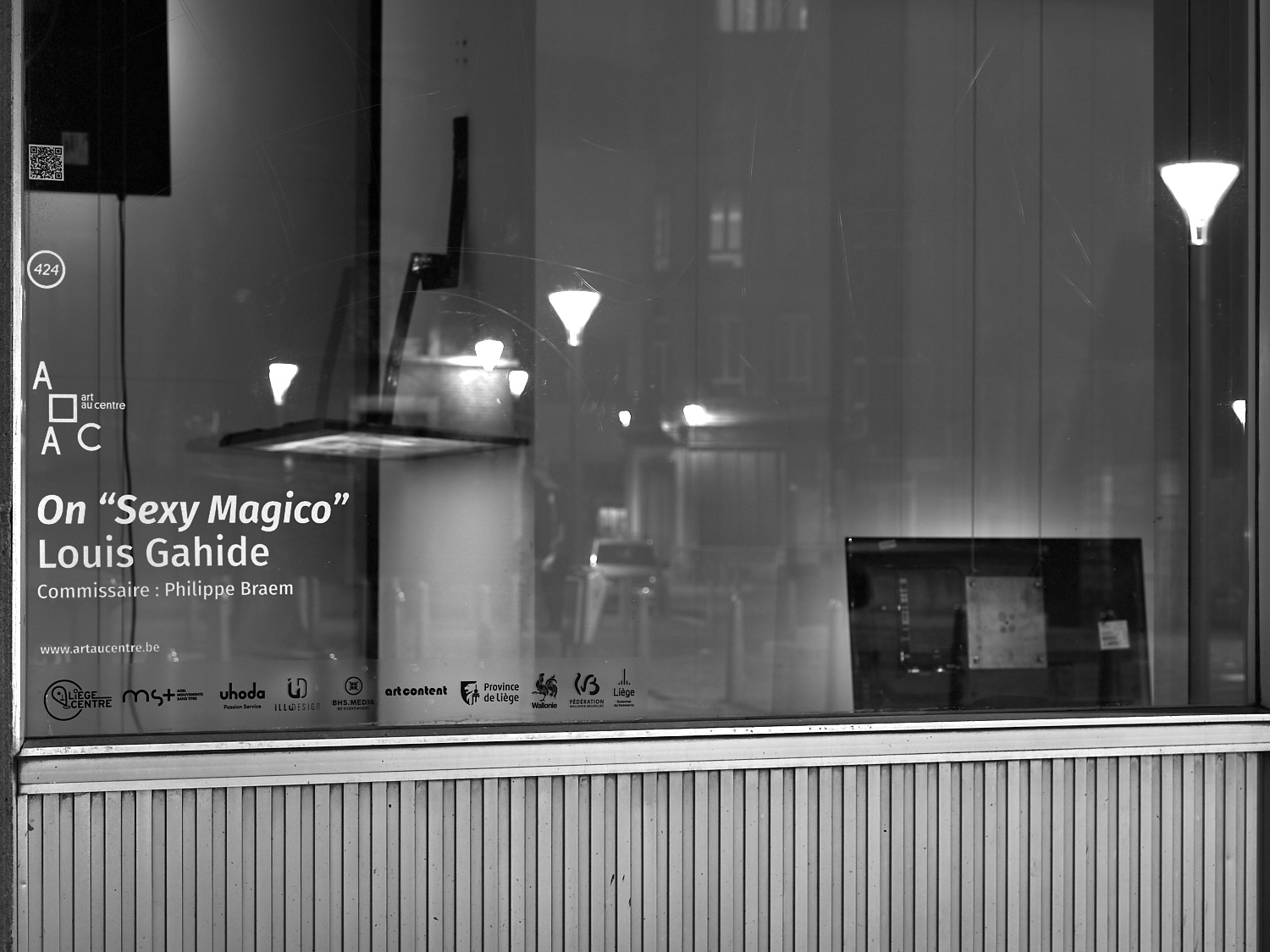
The installation I presented this year at Art au Centre #18, in Liège, shifts attention towards what I describe as the archive not-seen: films that exist outside institutional frameworks, found films to which no one lays claim, yet continue to exist and demand to be interrogated. These films are excluded from official archives, left in a state of abandonment, discovered in basements or flea markets, with no clear origin story, and are almost impossible to trace. What to do, then, with these films?
Just like other found-footage filmmakers, I perform the act of appropriation of found video material and recontextualise it to make a new film, often juxtaposing material from vastly different origins. At the core of appropriating film lies an inherent critique of the material you work with because you question its origin. Not every filmmaker who appropriates and recontextualises film works with material that is abandoned and left out of the public eye. Some even use film found in newsreels or on popular TV and the internet. What binds them is the critical eye towards the image or, to some, an uncontrollable fascination, as in Joseph Cornell’s Rose Hobart.
With this in mind, I, as a maker, still act with a most radical and direct form of criticism towards the image: erasure. Through a direct attack on the celluloid of the film in the form of scratches, tears, removal or bleaching, the viewer sees that criticism directly. In my Graduation installation, I did this to its extreme, scraping away all human-like figures. Though struggling with my position as a narrator, one with complete authority over the image, I presented the viewer with a dual reading: one of the new scratched scenes and one of the past. Claiming authority over the new, while keeping the troubled past intact.
While I was going through some 35mm film reels in the dusty basement of someone who was keeping them for ‘no particular reason’ (which I found hard to believe), there was no clear way to know what was within each reel, what images, stories, or ideologies lay hidden in the celluloid. The only hints were the titles scratched or labelled on the cans. Just going off of the title and first few frames, I chose some of the reels to take home. I now had a collection of my own.
One of them immediately caught my attention more than the others: a twenty-minute film fragment titled Sexy Magico. Since my interests lie in the marginal and forgotten side of cinema, in films whose legacies exist within forgotten genres, this reel, at first glance, seemed to contain all the familiar elements I had found many times before. Judging from the opening frames alone, given the nudity and the title, I initially assumed it was an Italian porno or one of these sexploitation films that flourished during the 1960s and 1970s. However, as I looked further into the reel, helped by its Dutch subtitles, a much darker historical layer emerged.
The film juxtaposes footage of rural Africa with scenes of women from the African diaspora performing stripteases and nude dances for white male spectators. Throughout, a Western gaze narrates over the film. Subtitles such as “Contrary to the Masaï [a tribe in rural Kenya], the Arusi from Gallo and Sidano in Ethiopia learned a lot from civilised Europe,” or “These civilised Africans don’t want to lose Europe and its civilised society,” or even outright racist dehumanisation: “The young Kikuyu eats the goat heart, what a hungry monkey!” show the objectification, hierarchy, and violence within the film.
As the reel unfolded, it became clear that the film contained a documentary impulse narrated entirely through colonial ideology. This narrator appears to justify Italian colonial presence in Ethiopia during the Mussolini years, and Western colonialism in general. What makes the film especially disturbing is the banal way these ‘anthropological’ sequences are edited alongside stripteases and erotic dance performances, resulting in a form of documentary with a deeply exploitative structure.
Marketed with the tagline “SHOCKING TABOOS… A FILM THAT WILL QUICKEN THE PULSE AND DELIGHT THE SENSES!”, Sexy Magico (1963) by Luigi Scattini and Mino Loy finds its origins in Mondo cinema. Mondo cinema is a genre occupying a contested position between documentary film and exploitation cinema — or rather, a genre that performs documentary authority while staging spectacle for consumption. Relying on shock, taboo and nudity, the films extracted African cultural practices and distorted them for Western audiences.
If we adopt the method of Palestinian-American Edward Said, a founding figure in postcolonial studies, and read mondo films contrapuntally (Said 1994, 79), as the Italian scholar Gaia Giuliani does (Giuliani 2018), we can identify them as prime examples of Orientalism in action: films that extract cultural practices from their contexts and simplify them for Western consumption, thereby reinforcing the notion of a superior West encountering the primitive ‘Other’. As is typical of the genre, the film openly acknowledges its exploitative logic, capitalising on taboo and eroticism while knowingly advertising its shock value.
When Said was describing the construction of the ‘Orient’, or, more generally, the ‘Other’, meaning everything positioned outside the West, filmmakers were already capitalising on exploitation cinema from other cultures. These films exoticised non-Western ways of life, turning the lived realities of the Other and their “primitivity” into consumable images. In doing so, they justified colonial domination and reinforced imperial hierarchies. By emphasising this otherness and exaggerating cultural distance, they widened the gap between Western powers and their former colonies, reproducing colonial narratives and propaganda through visual media.
The representational strategies in Sexy Magico resonate strongly with broader patterns in Italian, Mondo, and exploitation cinema of the 1960s and ’70s. As scholars like Giuliani have noted, Italian constructions of Africa and Africans were multifaceted, shaped by Marxist, anticolonial, and Gramscian discourses, yet also deeply entangled with Italy’s colonial self-representations and the fantasy of a “Mediterranean Africa” forged during the Fascist regime. Even when Italian cinema tried to engage with African or marginalised perspectives, it often repeated power hierarchies inherited from colonialism (Giuiliani 2018).
Within this lineage of Mondo cinema, Luigi Scattini’s films are particularly relevant. Scattini’s erotic-exotic trilogy revives the figure of the colonial Black Venus, played by the Eritrean actress Zeudi Araya, an image rooted in nineteenth-century Italian visual culture. This figure embodies exotic sexuality alongside fear, particularly anxieties about cannibalism and danger. Scattini’s films emerged during a period of intense social transformation in Italy, marked by feminism and major legal reforms, including the 1978 legalisation of abortion. In this context, the beautiful, obedient, and sexualised Black woman functioned as a reassuring fantasy for the Italian male spectator, offering a symbolic restoration of male dominance threatened by feminist politics.
While intended to neutralise feminist ideology, the nudity of the Black female body simultaneously reactivated fears of racial mixing and sexual transgression. Her body became stripped of narrative complexity so as not to threaten the viewer or voyeur, yet charged with erotic danger, since the Black woman is still seen as the Other. This dynamic operates as a reverse form of cannibalism: rather than the Black woman consuming the white man, the camera consumes her body, fragmenting it into spectacle and bait for the male gaze (Giuliani 2018).
From this perspective, Sexy Magico, Luigi Scattini’s first feature film, can be seen as an early example of the genre, released a year after Mondo Cane, directed by Gualtiero Jacopetti, Paolo Cavara, and Franco Prosperi and regarded as the founding work of Mondo cinema. The film’s colonial rhetoric, erotic imagery, and documentary pretensions produce a cinematic artifact that is historically revealing but deeply uncomfortable to watch. When engaging with such material today, the question is not simply how to interpret it, but how to look at all. Sexy Magico is not merely a historical artefact; its colonial rhetoric, erotic imagery, and documentary pretensions, when interrogated, continue to shape the present.
Viewed through the lens of found footage, Sexy Magico becomes less a closed cinematic text than a fragment whose meanings are unstable and contested. To re-encounter it is to confront the afterlives of colonial imagery and to question whether recontextualisation offers the most ethical mode of engagement. This tension formed the core of my own inquiry: how should material so deeply embedded in colonial violence be approached today?
VOYEUR OF THE PAST
When I first examined the footage, I wanted to sanitise it, remove its colonial language, eroticisation and Western gaze. Because of the way it was marketed, Sexy Magico also made a shocking impression on me. In an attempt to sanitise the imagery, I acted upon an act of erasure, like in so many other projects.
In this naïve act, I thought I could get rid of its narrative. But upon scanning it, the dynamics still lingered.
This method introduces further uncertainty. Where does my own voice sit within this process? Am I the finder of the footage, its interrogator, or simply a voyeur, since I’m the target audience, a Western consumer? What authority do I claim when re-presenting these images? Is there a correct way to handle material so deeply embedded in colonial violence, or is the absence of a clear answer to this question itself the answer?
The central reflection of this installation is therefore one of self-critique: a critique of that naive act of sanitising the material, and a broader question of authorship over found footage material. The video was produced through a colonial, Western gaze, and I exist within that gaze as its audience. My position is that of an onlooker, observing how the material resonates in the present and questioning how it can be interrogated responsibly. Rather than neutralising the voyeuristic gaze by adopting the role of the found footage artist — though appropriating and remixing the material into a new context — I choose to remain critical of my own act. I do not seek to recontextualise its meaning as something new. I am its voyeur.
Engaging with images produced through a colonial gaze requires confronting the limits of authorship. If I am not part of the diaspora represented, do I have the right to reframe these images?
Does critical intent justify the act of appropriation? Or do I, the artist, benefit from the same power structures that I seek to critique?
While presenting such material may challenge the ideological framework in which it was produced, it also risks instrumentalising the images for personal artistic gain. This contradiction is not easy to resolve.
Through this installation, I do not aim to offer (an almost impossible) moral solution. Instead, I seek to foreground the difficulty and ambiguity of working with found footage, particularly material shaped by colonial and exploitative histories. I do so by showing only glimpses of the film. It positions itself not as an endpoint, but as a starting point: an invitation to dialogue with the viewer, one that does not search for a single ethical resolution, but rather insists on recognising the problems posed by imperialism’s legacy in filmmaking and the tensions inherent in archival practice, found footage, and its appropriation.
Note: On “Sexy Magico” by Louis Gahide will be shown in Brussels (2026) at Hotel Carousel, a nomadic exhibition platform for emerging and up-and-coming video and media artists, on July 3-4 in Edmond, Koekelberg, and from August 27 to September 6 at argos centre for audiovisual arts as part of DivFuse.
This piece was originally published in Issue 1 of the print edition of Ordinary Matters magazine.
References:
Azoulay, Ariella. “Archive.” Political Concepts, July 21, 2017. https://www.politicalconcepts.org/archive-ariella-azoulay/.
Said, Edward W. 1994. Culture and Imperialism. Ist Vintage Books ed. A Borzoi Book. Knopf.
Giuliani, Gaia. “Razza Cagna: Mondo Movies, the White Heterosexual Male Gaze, and the 1960s–1970s Imaginary of the Nation.” Modern Italy 23, no. 4 (2018): 429–44. https://doi-org.kuleuven.e-bronnen.be/10.1017/mit.2018.32Ray, Carina E. “Decrying White Peril: Interracial Sex and the Rise of Anticolonial Nationalism in the Gold Coast.” The American Historical Review 119, no. 1 (2014): 78–110. http://www.jstor.org.kuleuven.e-bronnen.be/stable/23784414.

Leave a Reply